Friday, August 28, 2015

Michelle Boisseau Wins 14th Annual
Tampa Review Prize for Poetry

 
Michelle Boisseau
     Michelle Boisseau, of Kansas City, Missouri, has been named winner of the 2015 Tampa Review Prize for Poetry. Boisseau receives the fourteenth annual prize for her new manuscript, Among the Gorgons. In addition to a $2,000 check, the award includes hardback and trade paperback book publication in 2016 by the University of Tampa Press.
     Boisseau’s previous books of poetry include A Sunday in God-Years (University of Arkansas Press, 2009); Trembling Air (University of Arkansas Press, 2003), a PEN USA finalist; Understory, which received the Morse Prize (Northeastern University Press, 1996); and No Private Life (Vanderbilt, 1990). She has also twice been awarded a National Endowment for the Arts Fellowship for Poetry.
     Tampa Review judges commented that the poems in Among the Gorgons make “graceful and unexpected leaps from personal to mythic, tender to satiric, and tragic to comic in poems that elude predictability and command attention.”
     “The voice constantly surprises us with strength in unexpected places,” the judges said. “Boisseau shapes irony into an energetic force. Best of all, the poems work individually—they satisfy and stand fully on their own—while at the same time gathering force and resonance as the book moves confidently into a whole that is greater than its parts.”
     Three of the poems from Among the Gorgons have appeared on Poetry Daily. Other new poems have appeared in Poetry, Gettysburg Review, Yale Review, Hudson Review, Shenandoah, Cincinnati Review, Missouri, Southwest Review, Prairie Schooner, Miramar, New Ohio Review, and others.
     Boisseau earned BA and MA degrees from Ohio University and a PhD from the University of Houston. She is Professor of English in the MFA program at the University of Missouri-Kansas City, where she is also Senior Editor of BkMk Press and Contributing Editor of New Letters. Her university textbook, Writing Poems (Longman), initiated by the late Robert Wallace, is now in its eighth edition, with her colleague Hadara Bar-Nadav. She lives in Kansas City with her fellow Royals fan, her husband Tom Stroik, an internationally renowned linguist who writes on poetics, syntax, and the evolution of human language.
     Boisseau says that she nearly missed the contest deadline with her manuscript.
     “I believe I sent my manuscript at almost the last minute,” she says. “We had been in California visiting friends and family at Christmas. We got in late on the afternoon of December 31, and before we headed out the door for a New Year’s dinner celebration with friends, I managed to take a few minutes to get Among the Gorgons submitted. I pushed myself to take the chance, and what a fabulous result.”

The judges also announced twelve outstanding finalists this year:

     Ron De Maris of Miami, Florida, for “Spoor”;
     Diane Glancy of Shawnee Mission, Kansas, for “The Collector of Bodies”;
     Julie Hanson of Cedar Rapids, Iowa, for “Charmed in What Regard”;
     Jared Harel of Astoria, New York, for “Punch Card”;
     Berwyn Moore of Erie, Pennsylvania, for “What the Wind Said”;
     Brianna Noll of Chicago, Illinois, for “What Breaks through the Dark”;
     Katherine Riegel of Tampa, Florida, for “Kites Almost Too Strong to Hold”;
     Daniel Saalfeld of Washington, D.C.,  for “Sweet Tooth”;
     Phillip Sterling of Ada, Michigan, for “Some Play of Light”;
     Daneen Wardrop of Kalamazoo, Michigan, for “Stir the Lake”;
     Scott Withiam of Marblehead, Massachusetts, for “Desperate Acts & Deliveries”;  and
     Al Zolynas of Escondido, California, for “Near and Far: Selected and New Poems.”

     The Tampa Review Prize for Poetry is given annually for a previously unpublished booklength manuscript. Judging is by the editors of Tampa Review, who are members of the faculty at the University of Tampa. Submissions are now being accepted for 2016. Entries must follow published guidelines and must be postmarked by December 31, 2015.
     Complete guidelines are available at www.ut.edu/tampareview or by sending a self-addressed, stamped envelope to The Tampa Review Prize for Poetry, University of Tampa Press, 401 West Kennedy Blvd., Tampa, FL 33606.

Friday, August 21, 2015

Studies in the Fantastic Resumes Publication


After five years in suspended animation, Studies in the Fantastic, our peer-reviewed academic journal devoted to literary fantasy, science fiction, weird tales, and magic realism, resumes publication this year under the leadership of new co-editors Daniel Dooghan and David Reamer.  They have made a call for submissions and will consider new work for the next issue of the journal through mid September.

SUBMIT BY SEPTEMBER 15

In the spirit of new beginnings, the journal invites submissions on the subject of REBOOTS. Now a staple of the entertainment industry, reboots regularly appear on television, in movie theaters, on computer screens, and, of course, in comics. Although hardly unique to the fantastic—appropriation and retelling are historically common throughout the arts—many of the most visible recent examples of the reboot are in fantastic genres such as science fiction and superheroes. This issue of Studies in the Fantastic asks why these genres are so ripe for reboot. Approaches dealing with canon formation, intermedia adaptation, and cultural capital are encouraged. 

Submissions speaking to the “REBOOT” theme are especially welcome.

REBOOTS: RETURNS, REPEATS, REINCARNATIONS, RESURRECTIONS, RECYCLINGS, RECURRENCES, REPETITIONS, RE-TREADS, REINVENTIONS, RECOVERIES, RE-DOS, RESTORATIONS, REPLACEMENTS, REPLICATIONS, RECONCEPTIONS, RECONSTITUTIONS, REMOUNTS, REIMAGININGS, REALIZATIONS

Essays on other topics will also be considered. 

Send by September 15, 2015, with publication planned for the end of the year.

Studies in the Fantastic is a journal publishing referenced essays, informed by scholarly criticism and theory, on both fantastic texts and their social function. Although grounded in literary studies, we are especially interested in articles examining genres and media that have been underrepresented in humanistic scholarship. Subjects may include, but are not limited to weird fiction, science/speculative fiction, fantasy, video games, architecture, science writing, futurism, and technocracy.

Submitted articles should conform to the following guidelines:

1. 3,000-12,000 words
2. MLA style citations and bibliography
3. A separate title page with author information to facilitate peer review
4. 1” margins, 12 point serif font, page numbers

We look forward to seeing your work!  Please submit to:

fantastic@ut.edu

Daniel Dooghan and David Reamer, editors

Founding Editor: S. T. Joshi

Editorial Board: Sean Donnelly, Richard Mathews, and Elizabeth Winston

Wednesday, June 24, 2015

Peter Meinke Appointed Florida Poet Laureate: Florida Poetry is in Good Shape


One of Peter Meinke’s most popular books from the University of Tampa Press is The Shape of Poetry, his “practical guide to writing and reading poems.”  Now we are delighted to know that poetry in Florida is in great shape and good hands, since Peter has been appointed as Florida’s Poet Laureate.

Peter has been poet laureate for the City of St. Petersburg since 2009. This month Florida Governor Rick Scott named him to a four-year term as official Poet Laureate for the State of Florida. He becomes only the fourth Poet Laureate in the state’s history, stepping into a position officially established by the Florida Legislature in 2014. The state’s previous laureates were Franklin N. Wood, appointed by Gov. John W. Martin in 1929; Vivian Laramore Rader, appointed by Gov. Doyle E. Carlton in 1931; and Edmund Skellings, appointed by Gov. Robert Graham in 1980.


Peter is Professor Emeritus at Eckerd College, where he directed the creative writing program for nearly 30 years.  He has published eighteen books and chapbooks, including eight volumes of poetry in the Pitt Poetry series, and he has three books in print from the University of Tampa Press: Lines from Neuchatel, The Shape of Poetry, and Truth and Affection, all of them with drawings by Jeanne Meinke, his wife. This summer the press is working on its fourth Meinke book, The Elf Poem, another collaboration with drawings by Jeanne. It is an introduction to poetry for young people (and children of all ages), containing, as its subtitle states, “Less Than 10 Not Very Golden Rules for Children Who Like to Write Poetry.”

Congratulations to Peter (and Jeanne)—and watch for The Elf this fall from UT Press!


Wednesday, April 15, 2015

Announcing the new Tampa Review Online


This year as Tampa Review celebrates fifty years of publication we’re naturally looking back over the last half-decade to savor milestones and accomplishments. But we’re also looking forward to the next fifty years!  We expect they will bring even more changes as new media continue to offer new forms of literary publishing. We know there will be even more changes ahead, but to along with our 50th anniversary issues, we have also launched a new look and location for Tampa Review Online.

Starting last fall, our sibling on the Web, Tampa Review Online, originally created and edited by graduate students in the low-res MFA in Creative Writing Program at the University of Tampa, has been more closely linked in staff and content to the print edition of Tampa Review. At the same time, we have joined the launch of Project Muse Commons, a shared space on the Web for content and comment in the context of other university presses and nonprofit publishers that make up Project MUSE. A Johns Hopkins University-based digital collection of over 550 scholarly journals, Project MUSE represents 160 university presses and academic publishers. It now makes digital editions of Tampa Review available to about 2,700 college and university libraries around the world that are Project MUSE subscribers, and with the addition of Tampa Review Online we are able to offer content that complements and extends our print edition. 

TR Online currently includes an extended conversation about new art from China and the artists whose work appears in Tampa Review 49. Barbara Pollack, a New York-based independent curator and a leading expert on contemporary Chinese art, speaks with Katherine Pill, Assistant Curator of Art after 1950 at the Museum of Fine Arts, St. Petersburg. Together they explore many fascinating aspects of the Chinese art scene as they consider ways in which “the aesthetics of misinterpretation” play a role in international art.  Recent Tampa Review Prize poet Michael Hettich discusses one of the poems from his prize-winning manuscript that is featured in the latest issue, and there is a video link to Michael's reading of the poem. Also online, J. Malcolm Garcia, whose “My Middle Age” from Tampa Review 45/46  was named a “notable essay” in Best American Essays and who reflects on Syrian refugees in Tampa Review 49, has sent an email update about some of his current work.

The new Tampa Review Online will be a continuous source of creative writing and art published to the same standard as work in the print edition of Tampa Review. Fiction, nonfiction, poetry, interviews and conversations, as well as all forms of visual art will complement and expand the print edition of Tampa Review.

Read the Project MUSE Commons announcement about the new site, and visit

Thursday, April 9, 2015

Paula Brancato Wins Ninth Annual Danahy Fiction Prize


     Paula Brancato of Long Island City, New York, has been selected as winner of the ninth annual Danahy Fiction Prize by the editors of Tampa Review. She will receive a cash award of $1,000 and her winning short story, “Executive Spa,” will be published in the forthcoming Fall/Winter issue of Tampa Review.
     Brancato is a first-generation Sicilian-American writer with a business degree from Harvard and both Wall Street and Hollywood experiences informing her writing.
     “‘Executive Spa’ is one of a series of stories from my novel-in-progress called Never Iron Naked, loosely based on my growing up in the 1970s in and around New York City,” Brancato explains. ”While the Bronx was burning, disco reigned, and entire buildings stood empty in the inner city, a new generation of women had begun to fight their way into power positions in the mainstream. We came from difficult, parochial backgrounds, where a college education was rarely more than a hope and a dream.”
     Brancato is a graduate of Hunter College and the Los Angeles Film School. She also earned an MBA from Harvard, becoming one of the first women executives on Wall Street. She is also a filmmaker, music producer, and financial advisor working with hedge funds, family offices, and The World Bank, all of which have contributed to her unique voice.
     “We learned to make our way in foreign territory bringing our cultures, beliefs and creativity with us and forever changing business, the sciences, and the arts, ”Brancato says. “If you recognize this story it is because this is what young men always do, but we really were the first generation of women who had the full liberty to do so, often against what our families and the men in our lives had to say about it. After all, the Ivy Leagues only began accepting women in the mid-’70s, weird as that may now seem.”
     Brancato’s poems and stories have appeared in Mudfish, Bomb Magazine, Georgetown Review, Litchfield Review, Southern California Anthology, Ambit Magazine, and Georgia Review. She has received the Brushfire Poet Award, first prize from the Chester H. Jones Foundation, and the Robinson Jeffers Tor House Prize honorable mention.
     She explains that her business experiences are part of her fiction, “But this is not what I was thinking when I wrote this story. What I was thinking about was the feel of ironing, the warmth, the soothing sensation of the cloth, the smells and tastes of home and home lost, because that’s what it takes if you are going to move forward into new territory. It takes leaving everything and everyone behind. So, I remembered myself, alone, 17, making my own way in a city in a culture that was simultaneously bursting with life and falling apart. In three days I would be homeless. I had sunk so low there was nothing else to lose—and then what? Then what is this story.”

* * *
This year the judges also named four outstanding finalists for the Danahy Prize:

     “Ruth’s Red Ale” by Ann Stewart McBee of St. Francis, Wisconsin;
     “Rome” by Gretchen Comba of Richmond, Virginia;
     “Reclaimed” by Mary DiRago of Chicago, Illinois;
     and “Everything Nice” by Jill Rosenberg of Montclair, New Jersey.

* * *
     The Danahy Fiction Prize was established by Paul and Georgia Danahy as an annual award for a previously unpublished work of short fiction judged by the editors of Tampa Review, the faculty-edited literary journal of the University of Tampa, published twice yearly in a distinctive hardback format. Subscriptions are $22 annually, and those received before August will begin with the issue featuring Brancato’s prize-winning story.
     The Danahy Fiction Prize is open to both new and widely published writers, with an annual postmark deadline of November 1. The $20 entry fee includes a one-year subscription to Tampa Review, and all entries submitted are considered for publication.
     Complete guidelines are available online or by sending a self-addressed, stamped envelope to The Danahy Fiction Prize, University of Tampa Press, 401 West Kennedy Blvd., Tampa, FL 33606.

Friday, April 3, 2015

In Memoriam: Steve Kowit


     The editors and staff of Tampa Review and the University of Tampa Press mourn the loss of poet-editor-teacher Steve Kowit, 2006 winner of the Tampa Review Prize for Poetry for his collection The First Noble Truth and author of other books of poems, including Lurid Confessions, The Dumbbell Nebula, and The Gods of Rapture.  He also wrote the influential creative writing workshop text In the Palm of Your Hand: The Poet’s Portable Workshop.
     Steve passed away in his sleep in the early hours of April 2, 2015, at his home in Potrero, California, on Coyote Holler Road, in the San Diego area, near the Mexican border.  We were in the process of editing page proofs for his forthcoming collection, Cherish: New and Selected Poems, which will be published later this year by the University of Tampa Press. He is survived by his wife, Mary, who will complete the editing of this final collection.
     Tributes can be found on Steve’s Facebook page. He was a strong and vibrant force for poetry and a friend who will be deeply missed.

Friday, February 6, 2015

Southside Buddhist Wins Florida Book Award Honor


Southside Buddhist by Ira Sukrungruang, published in 2014 by the University of Tampa Press, has just been named winner of the Bronze Medal for General Nonfiction in the Ninth Annual Florida Book Awards recognitions.

        The Florida Book Awards were established in 2006 to recognize the best contemporary Florida literature. The annual selection is coordinated by Florida State University Libraries and has become the nation’s most comprehensive state book awards program. Eligible authors must be full-time Florida residents.
         
        This year more than 200 submissions were read and evaluated by juries of three members, each nominated from across the state by co-sponsoring organizations. Details about all of this year’s winners are available on the 2014 awards page of the Florida Book Awards website.
         
        Sukrungruang, who teaches writing at the University of South Florida in Tampa, is a Thai American writer. The autobiographical essays in Southside Buddhist include reflections on life, art, and writing. His previous books include his memoir Talk Thai: The Adventures of Buddhist Boy and a collection of poetry, In Thailand It Is Night, which won the Anita Claire Scharf Prize and was also published by the University of Tampa Press.

Both books are available on our website, or you can click directly to their catalog listings:


Friday, November 14, 2014

Celebrating Sixty Years of Craftsmanship

Sixty Years of Prints & Wood
Engravings
 (paperback edition)

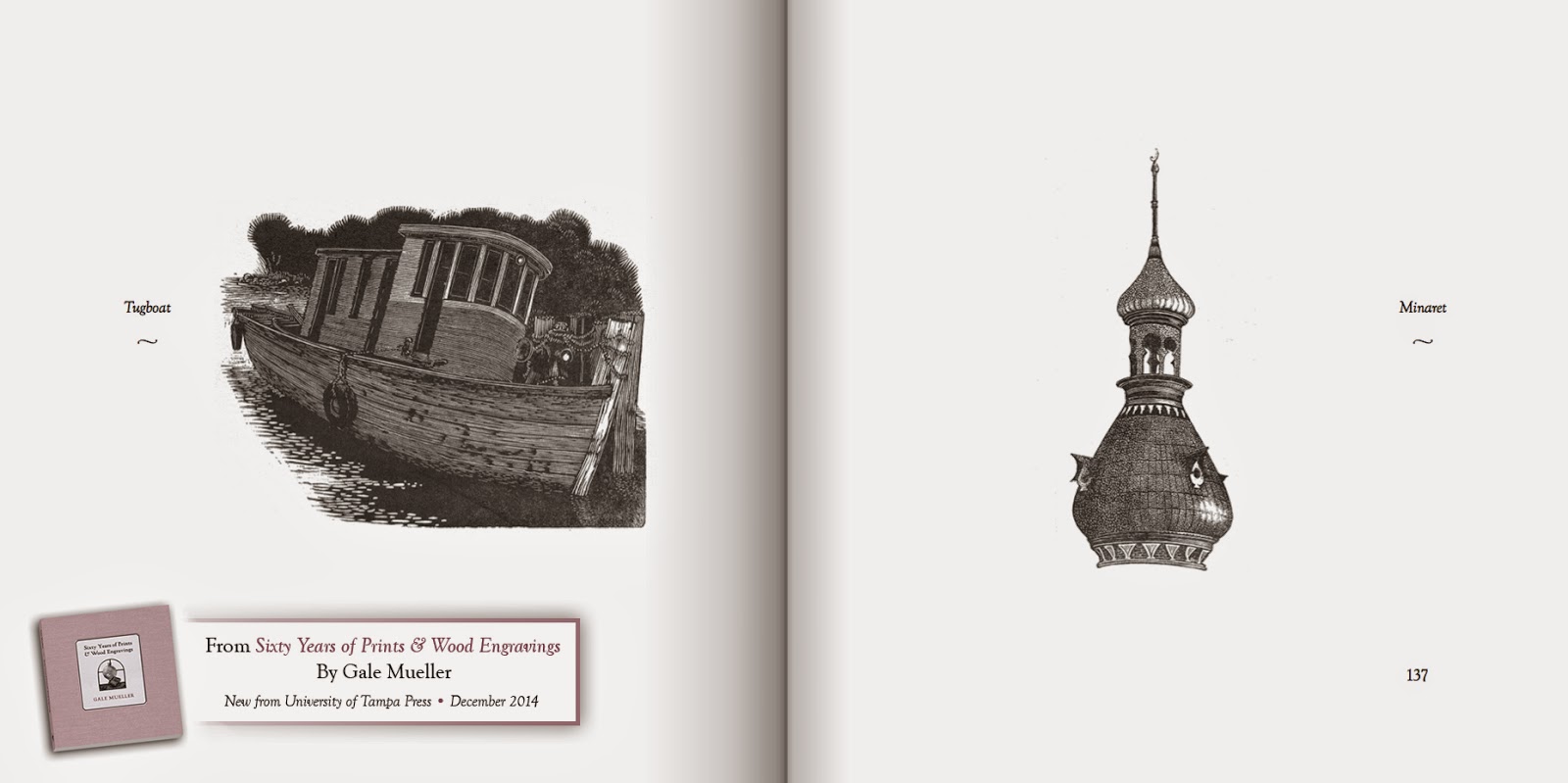
Spokane artist and craftsman Gale Mueller began making relief prints as greeting cards on a nipping press for Christmas 1953. In the sixty years and many prints that have followed he has excelled in his own flavor of skillful printmaking—and in the process become a much-loved and admired printer and wood engraver. Sixty Years of Prints & Wood Engravings, a new publication from University of Tampa Press, collects the evidence of this lifetime of printing to show what a substantial body of work can result from an activity one does out of love.

To heighten your anticipation of our upcoming December 1 publication of Sixty Years of Prints & Wood Engravings we’re glad to share a few spreads from the book and to present a special pre-publication purchase offer.

These few prints are only a small sampling of all that the book offers—Sixty Years of Prints & Wood Engravings reproduces over 125 prints, including 24 color reproductions of multicolor relief prints.

Click on each image for a closer view

From the “Barns & Doors” section

From the “Fauna” section

From the “Miscellaneous” section

From the “Portraits” section
Frederic Goudy, left, and Johann Gutenberg

“There is a distinctly personal dimension . . . at times humorous, occasionally whimsical but never inappropriate or gratuitous. It is his manner to observe the telling qualities of a subject, respect its uniqueness as he expresses it and then, often but not always, embellish it with a touch of his own unique essence . . . His work indicates that a human hand, guided by a human heart, has carved the design.”
– From the Foreword to the book by Welford D. Taylor –


– Special Prepublication Offer –
Sixty Years of Prints & Wood Engravings is available as a limited edition hand-bound hardback that includes a signed frontispiece wood engraving printed by the artist from the original block. This edition—limited to only 60 copies, only 50 of which are for sale—is available at a special prepublication price of $50—only through November 30, 2014. Price upon publication December 1, 2015, will be $60.


Sixty Years of Prints & Wood Engravings
is also available in a Paperback Edition.

Wednesday, October 1, 2014

Celebrating 50 years of Tampa Review: Tampa Review 49

Announcing the release of Tampa Review 49

TR49 is the first of two issues this year that will
celebrate a milestone—50 years of literary publishing.

         We are pleased to begin our fiftieth year by featuring selections from a unique and wholly new exhibition entitled, My Generation: Young Chinese Artists. The exhibition showcases a new generation of world-class Chinese artists who have emerged in China since 2000—all born after Mao’s death in 1976, marking the end of China’s Cultural Revolution. The exhibition is a collaboration between the Museum of Fine Arts, St. Petersburg, and the Tampa Museum of Art, and offers stunning visual evidence that Florida is fully engaged in global cultural dialog. The show runs here June 7-September 28, 2014, before traveling to Oklahoma City Museum of Art, where it will be on view October 25, 2014-January 18, 2015. The works speak for themselves while bridging the country and spanning the globe.
         The literary contents of TR49 reflect a new generation’s struggle with “Utopia”—as Qui Xiaofei visually depicts on the cover. Poet Zeina Hashem Beck also expresses it in her opening poem as she personifies a world “trying to tip over its pain.” Daniel Gabriel describes a utopian interlude in his 2009 visit to “Syria Before It All Went South.” By contrast, Malcolm Garcia struggles to find grounds for faith amidst horror and ruin in “Praying in Reyhanli.”

         Less destructive but deeply troubling is the singing war started by Mrs. Mudd in Jill Birdsall’s “The Beer Garden,” where experiences that promise harmony become discordant when inflected by greed, ego, and nationalism. Poet Michael Hettich takes a higher view in “Certain Constellations,” in which attentiveness to the natural world affirms the possibility of harmony if “we might move into/the circle of its song.”

         The issue concludes with struggles from our more recent past portrayed in Vincent Czyz’s “Straightsville,” set in the 1980s, mostly at a gay rally in Manhattan. The story’s narrator experiences a series of mutual misreadings that blur the cultural divide between New York and New Jersey, gay and straight, work week and weekend. Czyz’s story suggests, as does the speaker of Knute Skinner ’s poem “What I Have Assembled,” that selves are multiple, that they can be torn apart and reassembled in diverse ways, and that people and generations may be more alike than different.

         Finally, this first issue of our 50th anniversary year includes a few pages reproduced from the very first issue of Tampa Poetry Review in 1964.  They remind us how both our distant and recent pasts contain the cultural heritage and visionary struggles that create each new version of “my generation.” 

We have come a long way from our earliest mimeograph edition to our present hardcover format, and both of our issues this academic year will include a little taste of the journey through the past, while continuing to showcase some of the best contemporary writing and visual art from Florida and the world.

Tampa Review 49 includes:

Fiction: Jill Birdsall, Michael Cuglietta, Vincent Czyz, Dana Fitz Gale

Poetry: Zeina Hashem Beck, Robert Bense, Joshua Butts, Bill Christophersen, Mary Gilliland, Michael Hettich, Teresa Leo, Carol Levin, Lisa Lewis, Austin MacRae, Jenna Rindo, Roger Sauls, Knute Skinner, Kelly Talbot, Ralph Tejeda Wilson

Nonfiction: Daniel Gabriel, J. Malcolm Garcia, Aileen Kilgore Henderson, Laura L. Runge

Art: Birdhead, Cui Jie, Sima Diab, Liu Di, Qiu Xiaofei, Shi Zhiying, Song Kun

Tuesday, September 23, 2014

Poet Bruce Bond Wins 2014 Tampa Review Prize


Bruce Bond, of Denton, Texas, has been named winner of the 2014 Tampa Review Prize for Poetry. Bond receives the thirteenth annual prize for his new manuscript, Black Anthem. In addition to a $2,000 check, the award includes hardback and paperback book publication in 2015 by the University of Tampa Press. 
Bond is the author of nine published books of poetry, most recently Choir of the Wells: A Tetralogy (Etruscan, 2013), The Visible (LSU, 2012), Peal (Etruscan, 2009), and Blind Rain (LSU, 2008).  In addition he has four books forthcoming: The Other Sky (poems in collaboration with the painter Aron Wiesenfeld, intro by Stephen Dunn; Etruscan Press), For the Lost Cathedral (LSU Press), Immanent Distance: Poetry and the Metaphysics of the Near at Hand (University of Michigan), and Metaphysics of the Literal Heart (Four Way Books). 
Tampa Review judges commented that the poems in Black Anthem  left them “amazed and in awe of his poetic range and dexterity that revitalizes the sonnet form.”
“This is a manuscript that surprised us at every turn,” the judges said. “Bond plays the sonnet form like a master musician, making an old form continously new and fresh on page after page.”
“His eye and ear for language are remarkable‚” the judges added. ”Just as you think you've understood how rhymes, rhythms, themes, and sequences are working, Bond throws in another improvisation or flourish that deepens the poetic experience. You know to expect the volta, but have no idea where the turn will take you. His lyricism makes you want to go along for the ride.”
Bond’s background includes significant accomplishments as a classical and jazz guitarist, which may in part account for the musicality of language in this collection. In addition to his Ph.D. in English from the University of Denver, he also holds a Masters in Musical Performance from the Lamont School of Music and has worked as a professional guitarist.
Bond has previously received numerous recognitions for his poems, including the Allen Tate Award, the TIL Best Book of Poetry Prize, the Colladay Award, the Richard Peterson Prize, the Knightsville Poetry Award, and fellowships from the NEA and the Texas Institute for the Arts.  Presently he is a Regents Professor of English at the University of North Texas and Poetry Editor for American Literary Review.
 A sampling of poems from Black Anthem will appear as a “sneak preview” in a forthcoming issue of Tampa Review, the award-winning hardback literary journal published by the University of Tampa Press. Bond’s book will be released in the fall of 2015.
The judges also announced ten finalists this year: 
Brian Brodeur of Cincinnati, Ohio,  for “Persons of Interest”;
Polly Buckingham of Medical Lake, Washington, for “A Day Like This”;
Mark Cox of Wilmington, North Carolina, for “No Picnic in the Afterlife”; 
Tom Hansen of Custer, South Dakota, for “Body of Water, Body of Fire”; 
Judy Jordan of Anna, Illinois, for “Children of Salt”; 
Tim Mayo of Brattleboro, Vermont, for “The Body’s Pain”;
Robert McNally of Concord, California, for “Simply to Know Its Name”; 
Joel Peckham of Huntington, West Virginia, for “Body Memory”;
Brittney Scott of Richmond, Virginia, for “The Derelict Daughter”; and
Carol Westberg of Hanover, New Hampshire, for “Terra Infirma.”

The Tampa Review Prize for Poetry is given annually for a previously unpublished booklength manuscript. Judging is by the editors of Tampa Review, who are members of the faculty at the University of Tampa. Submissions are now being accepted for 2015. Entries must follow published guidelines and must be postmarked by December 31, 2014.

Complete guidelines are available at www.ut.edu/tampareview or by sending a self-addressed, stamped envelope to The Tampa Review Prize for Poetry, University of Tampa Press, 401 West Kennedy Blvd., Tampa, FL 33606.

Wednesday, March 12, 2014

Isabella David Wins
Eighth Annual Danahy Fiction Prize


ISABELLA DAVID OF RIDGFIELD, CONNECTICUT, has been selected as winner of the eighth annual Danahy Fiction Prize by the editors of Tampa Review. She will receive a cash award of $1,000 and her winning short story, “If the Meek Inherit the Earth, They'll Have Sons-of-Bitches for Lawyers,” will be published in the Fiftieth Anniversary Issue of Tampa Review.
     David is a French-American writer and actress, whose short story was partly inspired by her experiences as a “law spouse” at Washington and Lee University.
   “There were no other grad students in Lexington, so law spouses complained about being the odd men out (though most of us were women),” David says. “I got all the benefits of a small, tight-knit community without actually attending. The Black Law Student Association’s poetry meetings were the first time I read any of my writing aloud, and. . . . I became braver about sending my work out to be published instead of sitting on it as I’d been mostly doing. Now most of my friends are lawyers, and it was a wonderful opportunity for a shy writer.”
     David earned her degree in Comparative Literature and Languages from the University of Virginia, graduating early as an Echols scholar. She spent her senior year teaching high school French and English at a boarding school in Colorado. Subsequently, she moved to New York and began acting professionally on stage and in films in English and French. Along the way, in 2007 she won an award for Best in Festival at the Bad Plays Festival and in 2011, she wrote, directed and starred in a one-act play produced by Centerstage’s Friend Me Festival in Manhattan.
     David’s work has appeared, or is forthcoming, in The Lascaux Review, Slippery Elm, Contemporary Haibun, Interrupt Mag, The First Line Literary Magazine, Adbusters, Every Day Fiction, Every Day Poets, Postcard Shorts, and Postcard Poems & Prose among other places online and in print.
***
This year the judges also named six finalists for the Danahy Prize:

“Ruint Horse” by Thomas Atkinson of Anderson Township, Ohio;
“The Beer Garden” by Jill Birdsall of Rumson, N.J.;
“My Friend Bobby” by Michael Cuglietta of Orlando, Fla.;
“Fun With Color” by Dana Fitz Gale of Missoula, Montana;
“Natural Order” by Laurie Frankel of Corona Del Mar, Calif.; and
“For Mr. Potenza” by Ian Walters of Lafayette, Calif.

***
     The Danahy Fiction Prize was established by Paul and Georgia Danahy as an annual award for a previously unpublished work of short fiction judged by the editors of Tampa Review, the faculty-edited literary journal of the University of Tampa, published twice yearly in a distinctive hardback format and this year celebrating fifty years of literary publishing. Subscriptions are $22 annually, and those received before June will begin with the issue featuring David’s prize-winning story. The Danahy Fiction Prize is open to both new and widely published writers, with an annual postmark deadline of November 1. The $20 entry fee includes a one-year subscription to Tampa Review, and all entries submitted are considered for publication.

     Complete guidelines are available on the Web at http://tampareview.ut.edu or by sending a self-addressed, stamped envelope to The Danahy Fiction Prize, University of Tampa Press, 401 West Kennedy Blvd., Tampa, FL 33606.

Friday, September 20, 2013

John Bensko Wins Anita Claire Scharf Award


Tennessee writer John Bensko has been selected as winner of the second annual Anita Claire Scharf Award by the editors of Tampa Review. His new poetry manuscript, Visitations, will be published in Spring 2014 by the University of Tampa Press and the poet will be invited to read on the University of Tampa campus after the book is published next year.
     
     The Anita Claire Scharf Award is given to support publication of a book of poetry submitted to the annual Tampa Review Prize competition that significantly exemplifies or explores the interrelatedness of visual and verbal art and the interconnectedness of global cultures. The award is named in honor of the founding editorial assistant, and later associate and contributing editor, of Tampa Review who helped define the aesthetic and global values that are part of the journal’s mission.
     
     “This manuscript pushes beyond all kinds of borders,” said Richard Mathews, editor of Tampa Review, who worked with Scharf on the journal for more than seventeen years. “Anita always fostered thinking outside the box, and this prize manuscript pushes readers to enlarge their vision through imaginative leaps across time, space, and circumstance. And like Anita, Bensko has a special appreciation for the natural world, ecology, and visual art.

     “The poems of Visitations clearly delight in nature images—blooming lilacs, Sweet William, bayberry, persimmon, and even hornets with their ‘papery nest.’ We are unmoored from time and place to explore what it means to be fully human. It might be to savor a continuous strand of Southern culture—sugar cane, tobacco leaf, eroded fields, and old barns. But Bensko’s poems are visitations to multiple times and places and bodies. He allows us to inhabit both sides of a war, to move from the Hudson River Valley to Mississippi, or to
draw our souls through sheep, oxen, and shark. ”

     John Bensko’s previous three poetry books are Green Soldiers (winner of the Yale Younger Poets Award, Yale University Press), The Waterman’s Children (University of Massachusetts Press), and The Iron City (University of Illinois Press). He also has a story collection, Sea Dogs, published by Graywolf Press. His work has appeared in Georgia Review, Iowa Review, New England Review, New Letters, Poetry, Poet Lore, Prairie Schooner, The Southern Review, Shenandoah, and many other periodicals.

     He has been a Fulbright Professor at the University of Alicante in Alicante, Spain; and he teaches a summer creative writing course there through the University of Memphis, where he is a full-time faculty member along with his wife, the fiction writer Cary Holladay.

     “This manuscript shows remarkable craftsmanship and a sensitive ear for language,” Mathews adds. “The judges sensed the whole book coming together through metaphors from visual art near the end: ‘The brush along the canvas/leaves no more than a whisper. Still /the finished canvas must claim a voice.’ Bensko makes the universe into a canvas in the conclusion of this poem when he writes: ‘Above the leaves, heaven/cuts through
eyelids./It paints the body human/into the unseen gorges of the earth.‘ It’s a beautiful and stunning finish that Anita—and any reader—would applaud.”

     The Anita Claire Scharf Award is selected by the editors of Tampa Review from among the manuscripts submitted to the annual prize competition. Submissions for next year’s awards are now being accepted.

     To be eligible, authors are asked to submit a previously unpublished booklength manuscript. Judging is by the editors of Tampa Review, who are members of the faculty at the University of Tampa. There is a contest fee of $25, but each submitter receives a complimentary one-year subscription to Tampa Review. Entries must follow published guidelines and must be postmarked by December 31, 2013. All entries will be considered for both the Tampa Review Prize for Poetry and the Anita Claire Scharf Award.

     Complete guidelines are available at www.ut.edu/tampareview or by sending a self-addressed,
stamped envelope to:

The Tampa Review Prizes
University of Tampa Press
401 West Kennedy Blvd.
Tampa, FL 33606.

Congratulations to John Bensko! We're looking forward to the release of Visitations; watch for it in Spring 2014.